AI System Privacy Audit: Application Telemetry and Workflow Tracing
System in scope: doc_quality_compliance_check — quality telemetry persistence layer (quality_observations), workflow audit trail (audit_events), OpenTelemetry request tracing, Prometheus metrics, and the observability API surface.
1. System Diagram
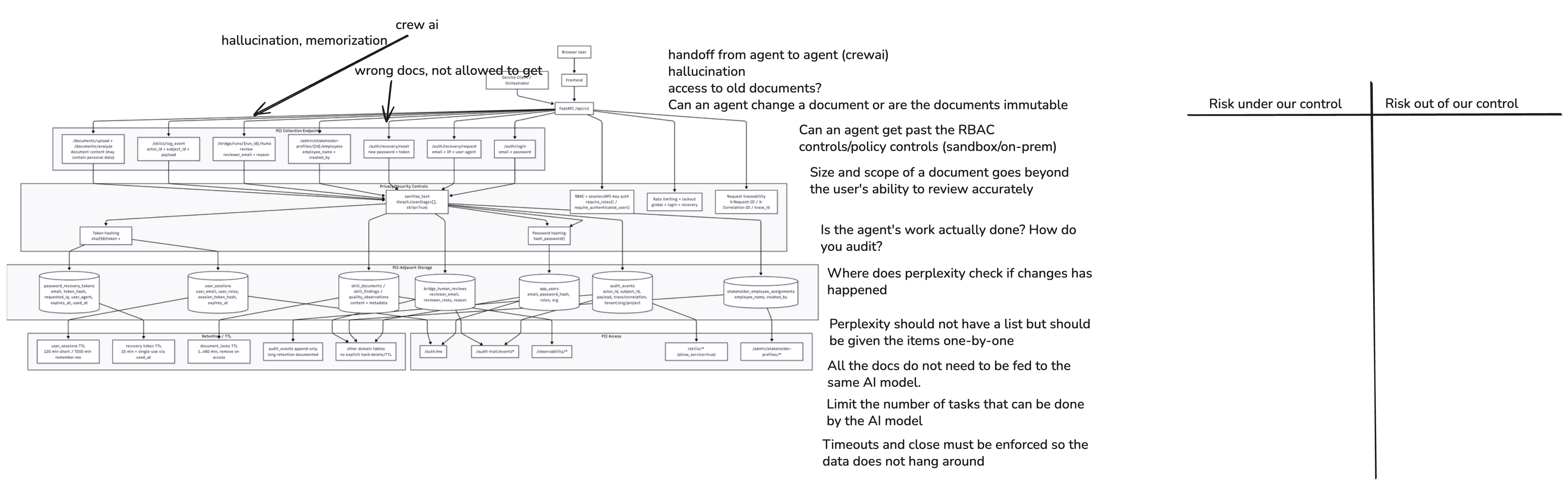
Telemetry-relevant architecture facts used in this risk sheet:
- The system implements a multi-layer observability stack: structlog structured logs, OpenTelemetry (OTEL) request spans, Prometheus metrics, and quality/evaluation telemetry persisted to PostgreSQL.
quality_observationstable (QualityObservationORM): stores AI quality signals per workflow step including a free-formpayloadJSON column that the application uses to embed rawllm_promptandllm_outputstrings (confirmed intest_observability_api.pyandOBSERVABILITY_LOGGING_README.md).audit_eventstable: append-only compliance trail with full provenance fields; thepayloadJSON column carries event-specific data, design intent is "no PII", but caller-controlled.agent_telemetry(referenced in persistence DoD): planned shorter-retention stream for non-compliance-critical operational signals — distinct fromaudit_events.- Observability API (
/api/v1/observability/*) is accessible to service clients (allow_service=True) in addition to human roles (qm_lead,auditor,riskmanager,architect). - The frontend Admin/Observability page renders raw
llm_prompt/llm_outputpairs in a "Rich GenAI Trace Payload" block and provides a CSV export of these pairs to the local filesystem. - OTEL exporter is configurable (
none/console/otlp); ifotlp, trace data leaves the system to an external endpoint.
2. Data Flow Analysis
| Data Flow | Source | Destination | Encrypted? | Logged? | Priority |
|---|---|---|---|---|---|
| Quality observation posted by workflow agent or orchestrator | Backend service / CrewAI orchestrator | POST /api/v1/observability/quality-observations → quality_observations (PostgreSQL) |
In-transit (HTTPS/TLS) | Persisted; no explicit pre-write redaction policy documented | High |
Raw LLM prompt + output embedded in payload JSON |
Workflow agent (e.g., research_agent, document_analyzer) |
quality_observations.payload column (PostgreSQL, at-rest) |
At-rest DB controls | Persisted indefinitely — no TTL or purge on quality_observations visible in schema |
High |
| LLM trace pairs returned via observability API | quality_observations table |
GET /api/v1/observability/llm-traces → API response |
In-transit (HTTPS/TLS) | Accessible to both human roles and service clients (allow_service=True) |
High |
| Audit event appended by Skills API or orchestrator | Backend / orchestrator | audit_events table (PostgreSQL, append-only) |
At-rest DB controls | Permanently retained; caller controls payload content; design intent is "no PII" but not enforced at DB layer |
High |
Prometheus metrics scraped from /metrics |
Backend API | Prometheus scraper / monitoring stack | In-transit (depends on infrastructure setup) | No authentication on /metrics endpoint observed in code review |
Medium |
OTEL span data exported (when TRACING_EXPORTER=otlp) |
FastAPI middleware / OTEL SDK | External OTLP collector endpoint | In-transit (TLS depends on OTLP endpoint config) | Spans include method, path, status, user-agent; path may carry document IDs or session context | High |
OTEL span data emitted to console (when TRACING_EXPORTER=console) |
FastAPI middleware / OTEL SDK | stdout / log aggregator | Same as structured log stream | Spans visible in application logs — see also Risk Sheet: Structured Logging | Medium |
| CSV export of prompt/output pairs | Frontend observability page | Browser local file download | In-browser object URL | Creates an uncontrolled copy outside the system; no audit log of export action | High |
agent_telemetry operational signals (planned, shorter retention) |
Orchestrator/agents | Dedicated table (retention config TBD) | At-rest DB controls | Retention TTL defined conceptually but not yet implemented in observed schema | Medium |
| Quality summary / workflow breakdown returned via API | quality_observations aggregation |
GET /api/v1/observability/quality-summary, /workflow-components |
In-transit (HTTPS/TLS) | Aggregated (no raw content); service-client accessible | Low |
Corrected interpretation for privacy and GDPR
- The
quality_observations.payloadcolumn is the highest-risk telemetry surface: it stores rawllm_promptandllm_outputstrings, both of which may contain personal data from submitted documents, stakeholder names, and reviewer identifiers. - The
audit_events.payloadcolumn carries a similar risk: while the design intent is "no PII", this is a convention, not a technical control — any caller can write personal data into the payload. - Exporting prompt/output pairs to a local CSV file is a GDPR incident risk: it creates an unregulated copy of potentially personal content on a user's device with no audit trail.
- GDPR Art. 5(1)(b) (purpose limitation) applies: telemetry collected for model quality improvement must not be repurposed for user profiling or commercial model training.
3. Sensitive Data
Sensitive Data: Raw LLM Prompt and Output in quality_observations.payload
- Category: Content-derived personal data — GDPR Art. 4(1); may include direct identifiers
- Examples:
payload.llm_prompt(document text submitted by user, stakeholder names, reviewer assignments),payload.llm_output(generated compliance summaries restating personal context),payload.provider,payload.model_used,payload.llm_temperature - Why Sensitive: Prompt context is assembled from user-submitted documents which routinely contain names, emails, project identifiers, and business-sensitive content; the output may restate or summarise that content; both are persisted to a queryable table
- Current Protection: Role-gated observability API; PostgreSQL at-rest controls; no pre-write redaction
- Risk (or Harm) if Exposed: Unauthorised access to document content and personal data via telemetry query; GDPR breach; misuse for model training outside the original purpose; profiling of document submitters from trace history
Sensitive Data: Audit Event Payload (audit_events.payload)
- Category: Compliance-critical record with caller-controlled content
- Examples:
payload.roles(user role at login),payload.remember_meflag, event-specific context fields, any free-form data inserted by orchestrator or Skills API callers - Why Sensitive: Append-only and intended for long retention; no technical control prevents a caller from writing personal data into the
payloadcolumn; combined withactor_id(user email) it forms a rich personal profile - Current Protection: Append-only service contract;
sanitize_text()applied to provenance fields; role-gatedaudit-trailAPI - Risk (or Harm) if Exposed: Compliance-critical records leaking personal data; inability to delete under GDPR Art. 17 due to append-only constraint without a selective redaction mechanism; cumulative re-identification from cross-event correlation
Sensitive Data: OTEL Span Attributes (when exporter is configured)
- Category: Operational metadata potentially linked to individuals
- Examples: HTTP
pathattribute (e.g.,/api/v1/documents/doc-abc123— document ID in path),user_agent,http.method,http.status_code,trace_id/span_id(linkable back to session) - Why Sensitive: When
TRACING_EXPORTER=otlp, span data is sent to an external collector; path values can embed document or session identifiers; user-agent can contribute to fingerprinting - Current Protection:
TRACING_ENABLEDand exporter type are config-controlled; sampling ratio1.0by default (full capture) - Risk (or Harm) if Exposed: Cross-border transfer of operational metadata to external SaaS OTEL backend without a GDPR Art. 28 Data Processor Agreement; correlation of user activity across sessions via trace linkage
Sensitive Data: Frontend CSV Export of Prompt/Output Pairs
- Category: Uncontrolled copy of telemetry data including personal content
- Examples: Exported
observability_prompt_output_pairs_*.csvfile containingprompt,output,source_component,trace_id, timestamps - Why Sensitive: Created on the user's local filesystem; outside system access controls, retention policy, and audit log; may contain personal data from documents processed during the export window
- Current Protection: Requires authenticated user in an authorised role to reach the export function
- Risk (or Harm) if Exposed: Untracked personal data copies; shadow copies on employee devices; GDPR Art. 32 security of processing gap; no mechanism to enforce deletion when user leaves the organisation
4. Privacy Risks
Risk 1: Raw prompt/output content persisted in quality_observations.payload without redaction
- Priority: High
- Risk Category: Data minimisation and telemetry redaction
- GDPR Reference: Art. 5(1)(b) — purpose limitation; Art. 5(1)© — data minimisation; Art. 25 — privacy by design
- Potential Harm/Impact: Personal data from user documents (names, identifiers, document passages) is stored in a queryable telemetry table with no documented TTL; accessible to all authorised roles and service clients; can be bulk-exported to CSV
- Ability to Implement Control: High
- Recommended controls:
- Apply a mandatory redaction/scrubbing step in
create_quality_observation()service before persistence: strip or hash identifiable content frompayload.llm_promptandpayload.llm_output(e.g., replace with content hash + length metadata). - Define a schema for permitted
payloadfields and reject or sanitise unexpected keys. - Set an explicit retention TTL on
quality_observations(e.g., 90 days for operational data; differentiate fromaudit_eventscompliance retention). - Separate "operational telemetry" (latency, scores, flags) from "content telemetry" (prompt/output text) into different storage tiers with different access policies.
Risk 2: audit_events.payload has no technical enforcement of the "no PII" design intent
- Priority: High
- Risk Category: Audit trail data governance and GDPR compliance
- GDPR Reference: Art. 5(1)© — data minimisation; Art. 17 — right to erasure (conflict with append-only constraint)
- Potential Harm/Impact: Any caller (orchestrator, Skills API) can write personal data into the
payloadcolumn of the append-only table; once written it cannot be deleted without custom redaction infrastructure; GDPR erasure requests cannot be fulfilled for data embedded in append-only audit events - Ability to Implement Control: Medium
- Recommended controls:
- Add a payload schema validator or allow-list of permitted payload keys per
event_type; reject or strip keys not on the allow-list before insert. - Implement a selective in-place redaction mechanism (
UPDATE audit_events SET payload = redacted_payload WHERE event_id = ?) accessible only to a privileged GDPR admin role — does not delete the row, replaces personal content with a redaction marker and records redaction timestamp and operator. - Document all permitted payload structures per event type in the data dictionary and enforce via code review gate.
Risk 3: Frontend CSV export creates uncontrolled copies of telemetry containing personal data
- Priority: High
- Risk Category: Data exfiltration and GDPR Art. 32 security of processing
- GDPR Reference: Art. 32 — security of processing; Art. 5(1)(f) — integrity and confidentiality
- Potential Harm/Impact: Authenticated users can download prompt/output pair data to their local device; the file is outside all system access controls, audit logs, and retention enforcement from that point forward; personal data in prompts/outputs can persist on unmanaged endpoints after the system record is deleted or redacted
- Ability to Implement Control: High
- Recommended controls:
- Apply the same pre-export redaction as recommended in Risk 1: serve redacted prompt/output pairs to the export endpoint.
- Add an audit event (
observability.csv_export) recording who exported, what time window, and how many records — this creates an accountability trail even if the file cannot be tracked. - Consider gating CSV export to a specific high-privilege role (e.g.,
qm_leadonly, notauditoror service clients).
Risk 4: Prometheus /metrics endpoint exposed without authentication
- Priority: Medium
- Risk Category: Operational data exposure and access control gap
- GDPR Reference: Art. 25 — data protection by design; Art. 32 — appropriate technical measures
- Potential Harm/Impact: The
/metricsendpoint exposes request counts by path and status code (dq_http_requests_totallabels:method,path,status). Path-level cardinality in Prometheus is normalised by UUID and integer scrubbing inobservability.py, but metric label values could still expose usage patterns (which document routes are active, error rates) to any unauthenticated network caller - Ability to Implement Control: High
- Recommended controls:
- Gate
/metricsbehind network-level access control (restrict to monitoring subnet / Kubernetes namespace only). - Alternatively, add a bearer-token check (
METRICS_BEARER_TOKENenv var) before returning the response body. - Verify that path normalisation in
_UUID_REand_INT_REfully removes document or session IDs from metric label values before they are stored in the Prometheus time series.
Risk 5: OTEL trace data sent to external OTLP endpoint without documented Data Processor Agreement
- Priority: Medium
- Risk Category: Cross-boundary data transfer and third-party processing
- GDPR Reference: Art. 28 — data processor; Art. 46 — transfers to third countries (if OTLP endpoint is SaaS)
- Potential Harm/Impact: When
TRACING_EXPORTER=otlpis configured, OTEL spans (including HTTP path, method, status, user-agent, trace context) are sent to an external endpoint; this constitutes a GDPR data transfer to a processor/sub-processor without a documented agreement; sampling ratio defaults to1.0(full capture of every request) - Ability to Implement Control: Medium
- Recommended controls:
- Default
TRACING_EXPORTERtonone(orconsole) in production until a Data Processor Agreement with the OTLP backend is in place and reviewed. - Reduce default
TRACING_SAMPLING_RATIOto0.1or lower for production to limit volume of exported span data. - Strip or hash path-embedded identifiers (document IDs, session IDs) from span attributes before export using an OTEL
SpanProcessorattribute scrubber. - Document the OTLP endpoint vendor in the GDPR Record of Processing Activities (Art. 30).
Risk 6: agent_telemetry retention policy is defined conceptually but not enforced in schema or application layer
- Priority: Medium
- Risk Category: Data retention and governance completeness
- GDPR Reference: Art. 5(1)(e) — storage limitation; Art. 25 — data protection by design
- Potential Harm/Impact: The persistence Definition of Done distinguishes
agent_telemetry(short retention, non-compliance-critical) fromaudit_events(long retention); however, noagent_telemetrytable definition, TTL enforcement, or purge job was found in the observed schema — meaning operational telemetry may be silently accumulating inquality_observationswith no enforced deletion - Ability to Implement Control: High
- Recommended controls:
- Implement the
agent_telemetrytable and purge job as defined in the persistence DoD (Phase 0). - Alternatively, add a
retention_classcolumn toquality_observations(operationalvsaudit_evidence) and run a scheduled job to delete rows whereretention_class = 'operational' AND event_time < NOW() - INTERVAL '90 days'. - Define explicit retention periods in the GDPR Record of Processing Activities and document the enforcement mechanism.
5. Cross-Sheet Consistency
| Control Area | Related Risk Sheet | Alignment Required |
|---|---|---|
quality_observations.payload redaction |
Risk Sheet 1 (Model Providers, Risk 2) | Same redaction policy must apply whether traces are triggered by external or on-prem model calls |
| Observability API service-client access | Risk Sheet 2 (RBAC, Risk 5) | Service-client access to llm-traces must serve only redacted payload; must be access-logged |
audit_events append-only GDPR erasure conflict |
Risk Sheet 2 (RBAC, Risk 3) | Access-decision audit log and the compliance audit trail face the same erasure-vs-retention tension — same selective redaction solution applies |
| OTEL exporter data processor agreement | Risk Sheet 1 (Model Providers) | OTLP backend must appear in the same sub-processor register as external model API providers |
| CSV export — uncontrolled copy | Risk Sheet 4 (Secrets/Tokens — pending) | Exported files containing model outputs should be treated under the same data handling classification as API responses containing model output |
Additional information from the repo
OpenTelemetry and logs (request workflow)
- Tracing:
configure_observabilityinobservability.pyregisters aTracerProviderwhentracing_enabledis true (OTLP or console exporter, sampling viatracing_sampling_ratio). HTTP middleware inmain.pystarts a span per API request and attaches standard HTTP attributes. - Logs: Each request logs
http_requestwithmethod,path,status,duration_ms, and optionaltrace_idwhen a valid span context exists.
These mechanisms trace API request execution, not a separate end-user “clickstream” product analytics layer.
Tests as examples of evaluation workflows
tests/test_observability_api.py demonstrates:
- Posting observations with
evaluation_dataset/evaluation_metricon non-evaluation aspects (still counted towardevaluation_observationsin the summary whenevaluation_datasetis set). - Posting
aspect: "evaluation"with LLM fields inpayloadand retrieving them via/llm-traces. - Populating workflow component breakdown with multiple
source_componentvalues.
Configuration touchpoints
- Service name:
TELEMETRY_SERVICE_NAME(e.g. in.env.example) feeds OpenTelemetryservice.name. - Tracing/metrics flags and OTLP endpoint: see
Settingsinsrc/doc_quality/core/config.py(tracing exporter,tracing_otlp_endpoint,metrics_enabled, etc.).
Related documentation
OBSERVABILITY_LOGGING_README.md— deeper operational logging and observability guide.README.md— Admin Observability overview and RBAC for/api/v1/observability/*.